October 15, 2012

My Inner Neanderthal


I am an introvert, possibly an extreme one. While not necessarily a hermit, I don't generally tend to function well in the world of corporate cubicles or even offices, find it difficult to navigate the vagaries of office politics, and don't tend to define myself in terms of my title or position in the hierarchy. I an a pretty good consultant, perhaps because I'm good at coming into an organization from the outside and seeing the strengths and weaknesses of that organization, but whenever I find myself either willfully or inadvertantly pulled into the maelstrom, there is a primal part of me that screams to get out of there as fast as possible.

The last decade has seen a radical change in the way that we have come to understand the evolution of the human race, largely as a result of our ability to sequence the human genome and see how we have evolved over time by determining when a particularly gene or allelle first appeared.

So, what does this have to do with office politics? It turns out that a curious incident occurred in the human genetic structure about 35,000 years ago - we interbred with aliens. Half a million years before, there was the first great migration of humans out of Africa, probably during a global warming period - food became scarce in East Africa, and some (but not all) of the early hominids stayed put.

Our record of their travels is limited, because the older the fossil record becomes, the more likely that human bones and remains would get destroyed by flooding, burial, wildfires and so forth. This process occurred a number of different times, and each time it would strand a portion of humanity in a different environment - coastlines along the Indian Ocean, on lands such as the British Isles that was only periodically connected to the rest of Europe and so forth.

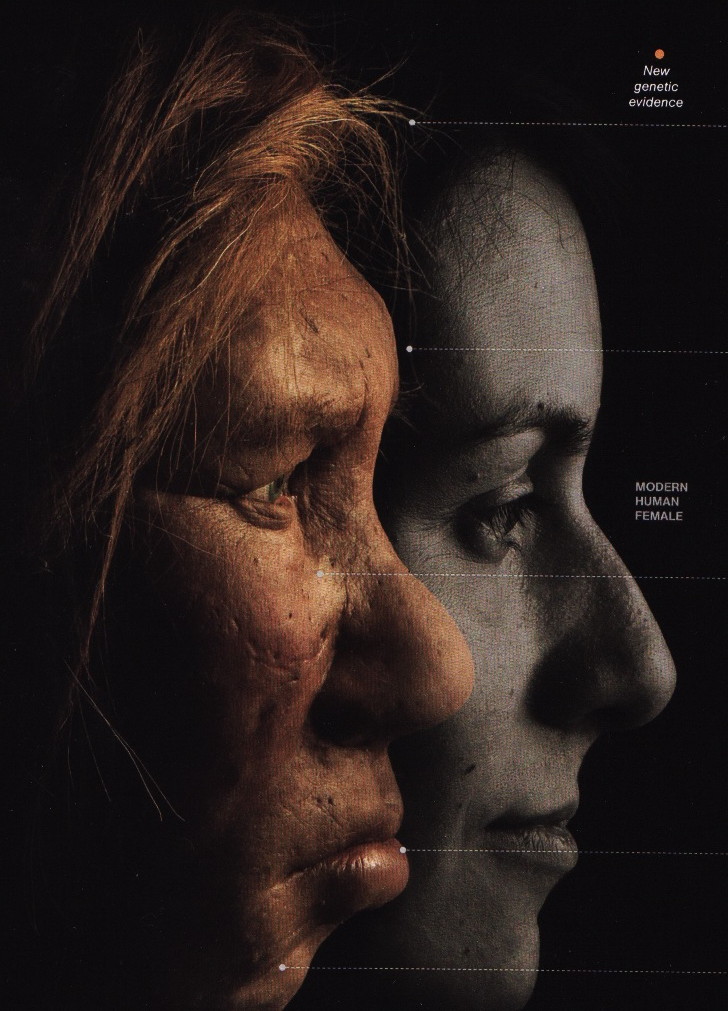
One of these stranded groups had gone north and west, forming a cultural group that extended from the area around Hungary, along the Volga north to Scandinavia and the Danube east to France and, across a land bridge that formed, to Prydhain, which would in time become the British Isles. When the glaciers came, many of these people died, but the ones that survived adapted, becoming shorter, brawnier of chest, their hair, going from brown-black to red, or to pale white in the Scandinavian regions. They became used to living in snall familial groups, and the survival skills they developed shifted from tribal hunting of large game animals to individual trapping of smaller animals - which meant that the skills that were emphasized tended to stress pre-planning, the development of more sophisticated traps, and long periods in relative isolation. Neanderthal women generally had to be more self sufficient, and both men and women were strong enough to handle many of the more physical activities that such a life demanded.

Over time, isolation started the process of speciation. These early humans adapted to their environment. During cold times, they would hibernate - their heart rate would drop dramatically, they would start metabolizing fat and they would sleep deeply for days on end. Their diet was high in protein (which could be converted to fat) though they did also eat nuts, grains and cold adapted fruits, which changed their dentition. They started communicating tonally - Neanderthal speech was probably more like song, whereas Cro-magnon speech was generally atonal and more consonant driven. They developed tonal musical instruments - nose flutes, for instance, early on as well (and possibly had other tonal instruments that have not survived).

They lived longer - a neanderthal could potentially live to be 140 years old, primarily based upon their hibernation. They could be brilliant improvisationalists, but tended to have poor cultural transmission (probably because the population was never very large). They also likely loved to fight, not out of hatred, but just simply because it was fun. They also partially domesticated animals early on - wolves in particular may have been domesticated first by Neanderthals. They periodically surfaced into conscious awareness, but for the most part probably lived in a timeless world of the subconscious - what people would refer to as a fugue state today.

Around 35,000 years ago, the ice retreated, and the CroMagnons that had been living in Northern Africa, the Middle East and Southern Europe followed. They met the Neanderthals, who had been apart long enough to be very nearly a separate species at that point, and the Neanderthals retreated to increasingly inhospitable areas - the Transcauscasus mountains in Hungary, Wales and the Highlands of Scotland, Finnland, the Basque region of Spain. They may have fought, but they also mated. It may have been that only Neanderthal men mating with Cro-magnon women were fertile while the other combination was not, or it may just be a sampling issue, but few people seem to carry Neanderthal mitochondrial DNA, although as much as six percent of the Neanderthal chromosome may have been infused in Cro-Magnon DNA.

A similar phenomenon happened (albeit farther back) in the Far East with Homo Denisovan. It's possible that the Denisovans and the Neanderthal were related, but also just as likely that Denisovans were just similarly cold adapted early hominids that ended up influencing the Melanesians and Australian aboriginals, to the extent that every so often a Melanesian is born with blonde hair, just as speciation had begun with East Asians developing epithelial folds as an adaptation to countering snow covered vistas.

The Neanderthals themselves were effectively absorbed by the Cro-Magnon, but their hybrid children gained both good and bad from both species. These hybrids likely tended to be intelligent, innovative, but not necessarily disciplined, were perhaps more pugnacious and less respectful of authority, preferred clan structures rather than disciplined hierarchies, as often as not had red hair, were argumentative and always loved a good fight, and were unusually gifted as singers. They were also more introverted, moody, and generally more restless around people, often seemed to be "fey-touched", were more easily depressed, and were more heavily influenced by seasonal change. If this sounds a lot like the Scots (and the Irish) this is perhaps not surprising. It is very likely that the Neanderthal population was high here 20,000 to 30,000 years before (and potentially that Neanderthals may actually have survived into more contemporary times, perhaps even 10,000 years before.

Red hair, in this case, may be the key. Red hair is rare in humanity - only 2%-3% of people globally have red hair, and even in Europe, that percentage is only about 6%. The places which have the highest concentration of red hair? Scotland, Ireland, the Basque region of Spain and Northeast Italy. While there's a tendency to think of the Norse as having red hair, this was generally true only after the Norse had begun raiding the West coast of Scotland (and intermarrying with the fiery red-heads there). Significantly, these are not far from areas where remains of Neanderthals were found. Red hair is due to the TRPM1 gene, which tends to occur frequently with the DRD4 7R gene. Most people in the world have DRD4 4R instead, but 7R shows up in Neanderthal DNA.

What make several of these areas intriguing is that the linguistic patterns of languages in this region predate the Indo-European waves coming from the Russian Steppes. While little remains of Pictish except for a few place names, those place names are distinctly unusual and don't follow the ancient Prydhain (very early Brythonic or Britannic) forms. While it's pure supposition (I would love to see genetic evidence here), it is possible that the neolithic Picts intermixed with the very early Celtic immigrants, and that these same Picts had Neanderthal ancestors (it's unlikely they were Neanderthals themselves, but there is evidence that this area had been inhabited from well before the last ice ages). Recently, a submerged land bridge has also come to light in the region to the north of the Hebrides that would have stretched, either directly or as a series of islands, all the way to Denmark during both the Ice Ages 12,000 and 14,000 years ago as well as the more intriguing ice age 32,000 years ago (England was also connected directly to the continent at those time), so it is possible in either of those scenarios for Neanderthal hybrids to make their way north, and then from there to travel along the Danube and other rivers directly to the Mediterranean. (The Norse followed the same route 1500-2500 years ago, and it seems to have been a natural trade route through Europe)

There are a few very ancient cultures in Europe that have puzzled historians and ethnographers for years. Three of the more intriguing including the Etruscans, the Scythians, and the Minoans. The Etruscans occupied an empire (Etruria) that at one time spanned from Latium, the future home of Rome, through much of Northern Italy and into parts of Greece and Switzerland. Their language bears some resemblance to the Minoans, and no resemblance to the Indo-European languages that originated in the Indus Valley. Intriguingly, red hair was fairly common among the Etruscans, and that trait manifested itself most famously in the red-haired Julius Caesar, an anomaly in the mostly dark-haired Romans. This hints that Neanderthals-Cro-Magnon hybrids may have settle Etruria from the north before the wave after wave of Mongol-derived inhabitants flooded the region.

Like the Etruscans, the Scythians are also shrouded in some mystery. Their name derives from the use of the Scythe as both a harvest tool and a weapon. It's likely that Scythia was a melting pot - a successive wave of proto-Persians streamed into the region from the south, meeting and intermarrying with the northern hybrids, creating a number of competing "countries" in the region. Among these were the Sarmatians, who lived on the Eastern border of Scythia. The Sarmatians were a semi-nomadic culture, but were unusual in that Sarmatian women were allowed to become warriors (something very rare in the Indo-european cultures), and these women may have ended up becoming the historical basis for the Amazons. Recent unearthed Ukranian burial grounds has proven unequivocably that Sarmatian women were honored as warriors.

Again, the record of the mythical Amazons (and some evidence of the historical Sarmatians) indicated that blonde hair was the norm in this culture, and that both men and women were large of frame and stature and heavily bearded. While no direct evidence for red hair exists here, the physical appearance and beardedness (Mongol beards tend to be slow growing and black) is suggestive. Moreover, some aspects of Sarmatian decoration are similar to those found both in Etruria and the Minoan culture, and again contrary to the pattern of the Indo-European invaders. Even more intriguing is the fact that Neanderthal remains have been found in caves in Croatia (within the same general area as Sarmatia) dating to 32,000 years ago, and Neanderthal suggestive fire sites have been found to 24,000 years ago.

Going on a very speculative limb here, it's possible that there was an arc of Neanderthal "settlements" that stretched up the Danube from the Middle East to Brittany, across the landbridge that crossed the English Channel, and that extended as far west as Ireland. The repeated ice ages and thaws forced the Neanderthals to alternately expand outward or become isolated at various times. As the diapora begun from East Africa up through the Middle East to the Indus Valley, the Neanderthal intermarried in the highlands (where their cold tolerance gave them a distinct advantage) but were defeated in the lowlands. Neanderthal hybrids would have the best of both worlds, physical strength and the deep thought processes that came from the semi-conscious Neanderthals (in the sense that they had comparatively little time sense), and ended up forming pockets in Sarmatia, Etruria, Northern Israel, possibly Mycenae in Greece, Spanish Basque, Brittany and Prydhain.

However, as the Earth warmed (due in part to increasing agricultural outgassing and slash and burn farming), even these descendants of the Neanderthals faced increased pressures. There's some evidence that both the TRPM1 and DRD4 7R genes are declining in the population overall, and may in fact become extinct within the next 200-300 years. On the other hand, the rise of "Silicon" outposts may be reversing this trend somewhat. The rise in Aspergers and high functioning autism (which may in fact be a manifestation of Neanderthal like mental characteristics) in areas like San Francisco, Seattle and Boston coincide handily with the growth in "Geek" populations there - software developers, engineers, artists and so forth. It would be worth doing a genetic study to compare the prevalence of DRD4 7R in those populations as compared to elsewhere in the US.

So, it may very well be that my dislike of offices stems from my Neanderthal heritage. Or it may not, but it's an interesting line of speculation nonetheless.

October 8, 2012

Notes from my Phone #1

Student in India using iPad at school.
After that last megapost, I decided to do a much shorter one on my phone, primarily to test out the Blogger mobile interface. Overall, it seems to work, using an external portable bluetooth keyboard to enter in content.

Today is the start of my post ACA career. I left on a high note, I believe, and am putting the final touches on a business process engine in MarkLogic that should both make things a lot easier for the application developers and make it possible to build workflow management pipelines without too much effort. This works by recognizing that a great deal of "enterprise bus processing" can be expressed as a series of transformations and validations on a given internal document as it moves from one state to the next.
ESBs work on the principle of moving documents around, but I'm coming to realize that by looking at "resources" (internal, abstract documents) as being in a workflow state as part of a workflow graph, you generally don't need to move the document around at all. 

I'm still pulling the pieces together, but if I work it right, I could end up replacing a lot of Java code, Of course, that may not necessarily set well with the people WRITING that Java code,
Interesting piece in the Washington Post this morning, talking of things technical. It seems that kids under the age of ten don't know what a mouse is.  Schools have been scrapping large, bulky desktops for pads with specialized "desktops" for a few years now - not only are they cheaper, but they are usually easy to locate, provide a more intuitive interface, and can go home with students in order to facilitate homework.

Discussions at Norwescon and on online educational forums seem to support this - we're in the midst of a computing revolution in the schools, Haven't investigated this area much yet, but I wouldn't be at all surprised if there's a tablet equivalent of Hypercard waiting in the wings, if not already deployed, More on this soon.

October 7, 2012

So What Comes After the American Dream?

A blacksmith, from the
Assassin's Creed video game..

The American Dream is a remarkably powerful piece of mythology. Stated simple, it is the belief that "If you work hard, if you play by the rules, you will succeed in America." It is so embedded in our national psyche that few in this country, until recently, have questioned it, despite the fact that it actually runs counter to history not only here but abroad as well.

"Work hard and work within the system, and you will be rewarded for your efforts" also sounds like the foundation of modern Capitalism, but again, it is a truism that gets remarkably slippery once you actually try to apply it to the real world. We live in a country where the differences in pay between the wealthiest and the poorest - or even the wealthiest and most of the inhabitants of the country, is astronomical - quite literally. The median income in the United States is about $50,000 for a person with a bachelor's degree. The total wealth of that same person in terms of house, vehicle, investments, etc. as well as income is roughly double that, or $100,000.

The upper echelons of the uber-wealthy start at about the $1 billion dollar mark. To put that into perspective, that's $1,000,000,000 or five orders of magnitude higher. That means that, before taxes, an individual would have to work 100,000 years to get to the same level of income. Given that this is roughly how long as it has taken for human beings to go from living in caves and fighting off saber tooth lions to today, the idea that one can in fact get to be a billionaire by working hard is actually pretty laughable.

You pay taxes. You buy food that continues to rise in price, to the extent that cereal manufactures are faced with the very real problem of being able to get bulkier cereals into their boxes because they have been shaped too thin in order to hide how little you're actually getting. You have to pay for gas that seems to be permanently ensconced around $4 a gallon. You put your kids through school, and then the racket called "higher education". By the end of the year, if you're lucky, you've socked away maybe a few thousand dollars in your savings account, which gets negative real interest (you pay to save).

So, once you do the math and look at how long it will take to save up that first billion, you're now in the 100 million year category. The dinosaurs were still around at that point, and would be for another 40 million years or so, and the continents were still reeling from just having split apart a few billion years before. Now, chances are pretty good that you will drop dead from overwork long before you even get to that first $100K in the bank that's "discretionary savings" - what used to be called wealth.

So, suppose that you don't have those wealthy parents, you have to win at the "lottery economy". What's that? The lottery economy is actually pretty close to the economy we have today. In the simplest example, you buy a ticket and defying all odds, you win the lottery. However, a more subtle form of this is in the entertainment world. You get blessed with a handsome face and hot body (or a pretty face and attractive curves), and then put some work into making those attributes pay off. Or you have a good singing voice, or you play ball very well, or you have a strong sense for acting, or you otherwise have physical attributes and natural talents that can, with a lot of work and effort, get you considered for the big time.

Yet that "big time" is still a lottery. For every supermodel there are 10,000 young women who are as beautiful but didn't have the right qualities for a particular ad campaign or casting call. For every scientific discovery, there are thousands of scientists who struggled with the same problem but didn't have the right samples. For every Michael Jordan, there are thousands of young men who for one reason or another never quite hit the big break.

Now, that doesn't mean that hard work is not important here - it absolutely is. You are trying to prove yourself better than millions of other people, and to do that you have to work hard. Yet ultimately, there is almost invariably a lucky break involved that catapults you out of the unwashed ranks into the ranks of superstardom (and almost always to the very lowest levels even there).

This holds as true in business as it does elsewhere, perhaps more so. If Bill Gates had started Microsoft in 1990, Microsoft would likely be nowhere as successful as it eventually became. Google survived by changing the paradigm of search on the web. Apple did not build the first personal computer, only the  first such computer that was designed as a consumer product. In order for these companies to have done as well as they did (how's that Facebook stock doing for ya?) they had to fill a niche that existed for a very tiny window of time, then had to be ruthless in keeping others from that niche long enough to survive.

A secretary working for Microsoft in 1980 would be a millionaire today if she'd been granted stock options (as most were at that time). Did she materially make a difference in the future of the company? Probably to the extent that any secretary would have. That secretary probably was less important in the scheme of things than a systems programmer twenty years later, but by that time, Microsoft's stocks had plateau'd. The opportunity had passed.

This is especially true for investors, which is the ultimate lottery. How many times have you heard "If I had only bought Apple or Starbucks or Microsoft at the beginning, I'd be rich right now!"? Yet, the reality is that most people have comparatively little discretionary income. A few people get rich by lucking out - picking the right stock at the right time. In most cases, though, the very wealthy get even richer by hiring people to invest in a lot of stocks that might in fact take off, then selling off those that fail early. To do that, you need money to be able to absorb losses while waiting for the hits to happen. You can still lose everything, but because you have the luxury of diversifying your portfolio, in general losses in one area are typically offset by significant gains in another - and if you can then right off those losses as tax write-offs, you're actually not losing all that much money.

There's a certain threshold that separates the wealthy from everyone else. The exact value varies, but currently it's around $10 million dollars. Below $10 million dollars, the drag on wealth from various factor in the economy makes it harder to accumulate wealth. Above $10 million dollars, wealth becomes self-perpetuating - so long as your wealth is reasonably well managed, it will grow with very little risk to the wealthy, because debt works in the person's favor.

In that respect, it's worth thinking about the lottery economy as being a rocket, and that threshold is escape velocity. Any rocket that goes up will ultimately come down, though it may be in a high enough orbit that it will take a while to escape the gravitational well of the earth. However, once it hits escape velocity, the force of gravity acting on it is not enough to pull it into a parabolic orbit, so it is able to go to the moon or be shot out into the solar system.

In some cases, this can be a multistage effort - even if one generation doesn't quite hit that threshold, a success (against less gravity) for the next generation may very well do it. Thus, to become wealthy takes a lot of work and a lot of luck, but to stay wealthy requires simply not doing stupid things, once you're above that magical threshold.

Not doing something stupid unfortunately usually involves not doing something criminal, and that's where things get problematic. Wealth can be used to buy power. That's not a new thought - the wealthy were buying governorships in Rome and were probably buying Ziggurat Rulerships in Mesopotamia. It's usually not hard to find some poor, hard working civil servant that could use a little extra to buy that nice house in the country, and with enough money, you can buy votes or even better vote counts (usually by "helping" your favorite candidate into the office of his choice, at which point he becomes YOUR congressman or member of parliament).

Yet there's also been a fairly long time understanding in the fact that businessmen in general make for poor civic leaders, for the simple reason that being a civic leader means insuring the welfare of the people over who you govern, while being a businessman involves eliciting the maximum amount of profit from an investment. These usually are antithetical goals, because maximizing profits typically requires that you are exploiting all of the available resources within a region as quickly as possible, without necessarily worrying about long term viability, while governing a region is essentially attempting to make it sustainable over the long term, even at the potential cost of short term profits.

Civic institutions and financial institutions move with different frequencies, and have throughout history. Throughout much of the Middle Ages, the church generally played the role of the banker, attempting to gain political power large through control of monetary policy, and political leaders tended to move closer to or farther from the church based largely upon the state's need for money - to pay for troops, supplies, equipment, horses, and weaponry. Both Germany and England broke from the Catholic church in great part because the rise of mercantile trade significantly enriched these country's coffers, and as such they were able to reduce the degree to which papal "strings" could override local autonomy. 

However, one consequence of that was that the mercantilists themselves found themselves in the position the church had occupied - providing money to the state for investment in exploration and colonization in return for increasing political power. In England, a cash hungry monarchy made it possible to buy and sell lordships, and many a minor lord, left with the upkeep of the moldering family mansion and increasingly losing the rents due from tenants on those lands as mobility picked up, were perfectly happy to sell their inherited titles to the highest bidder. Similarly many extinct lineages were bought up (usually with some folderol about service to the crown) by wealthy mercantilists who then used the political power to further their own business agendas.

Civic administrators generally are not interested in empires. They've developed a working equilibrium with the people under their care, and they know the cash inputs and outputs in their domain. Empires are for mercantilists who are seeking to exploit cheap materials and potentially cheap labor in order to maximize profits, and in some cases to build captive markets. When mercantilist pressures are strong (when the merchant class has largely taken control of the political class) you end up with periods of exploration, wars, exploitation and schism.

The problem with the "American Dream", is that it is dependent upon a highly mercantile state where its client states standards of living are farthest apart. As those client states dry up (or become more autonomous), the empire weakens. Resources that had essentially been subsidized due to the high differential between extraction costs and standards of living of the client vs. imperial states begin to become more expensive as the resources get used up and the standards of living equalize, and this in turn manifests as a diminishing standard of living in the host. 

One way of thinking about this is to consider that a business started in 1950, if it manages to survive to 1980, would likely have generated huge dividends over its lifespan. The same business, however, started in 1980, would generate far smaller dividends, accounting for inflation. Most business started in 2010 will likely generate comparatively little in the way of earnings over its lifetime, likely enough to pay for the wages of its employees and materials, but with razor thin profits. This is primarily due to the fact that for most people, discretionary income has diminished as the influence of empire has dropped.

The mercantile class is not immune to this - indeed, they are directly impacted by this. In times past, this typically ends up in an attempt to more directly control the political class in order to continue to steer government policy their way. However, while when standards of living are generally high and the labor class participates in the benefits of the wealth pump that is part and parcel of empire, when standards of living drop for the labor class, resistance builds up to the inequal distribution that tensions rise. In this case, the mercantile class overreaches and attempts to take control of the state directly. This is happening today in Greece, Italy, Spain and elsewhere in Europe, and was one of the big drivers of the Jasmine Spring in 2012 as well as the Occupy movements in the US and elsewhere.

At this stage, the American Dream is dead. There are an insufficient number of "niches" or opportunities for a startup company to grow, and this in turn means that ascending into the lower realms of the wealthy occurs only by "lottery", with that lottery happening less and less often. The wealthy in turn, realizing that their wealth is in danger, start moving it (and themselves) out of the country, away from the political class, in a move very reminiscent of the church during the Reformation. The political class, which derives it's power either directly or indirectly from the people, begins to turn what had been previously "legal" activities (legal in the sense that the financial class had managed to get protections enshrined in law) into "illegal" ones, in order to prevent abuses happening in the future.

Like most systems, empires do not die all at once. There is usually an overshoot period, where the resource pump is beginning to dry up - in the US this happened around 1971, when the US was no longer able to rely upon its internal energy and resource stores and so begin importing oil, as well as implicitly pulling out of the Bretton Woods agreements of the mid 1940s. American oil companies had already managed to control many of the major oil producing countries of the world, but one by one these countries have been nationalizing their oil production. Standards of living for the labor and professional classes peaked and began to decline even as the standard of living for the rentier or mercantile classes continued to rise all starting around the same period.

Global oil production peaked in 2005, and has been sitting on a plateau ever since. New oil discoveries are still being made, but the quality of those discoveries is declining, and the cost of exploiting them is rising to a point where there is an insufficient profit motive to be gained. What's more is that at a certain price point, oil becomes too expensive in a deflationary environment for certain levels of economic activity to occur, and so the economy shifts to a lower economic state. Currently economic activity is roughly on par to where it was in 1992, despite a significantly higher population, and there are indications that unless the economy is radically realigned, it will enter back into recession.

The mercantile class is not uniform. At any given time, there is usually an established "old money" class and an emergent "new money" class. The old money was once new money - years or generations ago, the people in this class took advantage of an emerging niche in order to catapult themselves up from the labor class. In this case, that original class emerged in the 1930s, 40s and 50s in the petroleum, chemical processing, munitions, aviation, transportation, real estate and insurance finance industries, all areas that had ties either to supporting the troops during World War II or enabling the buildup of the suburban landscape as the troops were coming home. This was also the period of biggest buildup for the Christian evangelical movement, which can be thought of as Big Religion. These are all empire building industries.

The new money of the mercantile class consists primarily of those industries that are related to information technology and dealing with the consequences of the old money industry - information technology, mobile communication, alternative energy, non-petroleum oriented transportation, biomedical research, nano-materials engineering, as well as alternative publishing and the Internet. These rely upon the complexity of the previous industries, but increasingly are trying to break those dependencies, and this delinking will only increase over time (the primary dependency increasingly is upon rare earths, which may be a critical weakness of these techs).

What differentiates the two is that each ultimately has to do with how the economy is structured. Much of the economy of today is still built around the command and control structures that emulated the military structures that soldiers returning from war were most familiar with, an economy in which labor was at the bottom under a pyramid of increasingly well paid supervisors, managers, vice presidents and CEOs. The person at the top was the equivalent of a four star general. The new money economy, however, is far more distributed, with fewer layers of managers, increasingly with creatives (designers, engineers, artists, writers, programmers, etc.) interacting as separate contracting entities, and consequently far smaller. A lot of management is mediated electronically, and wealth usually tends to be distributed as shares in ventures.

This model requires fewer people - not just slightly fewer, but significantly fewer, and those fewer people generally need to be more competent in their areas of specialty. This doesn't just hold true in software companies - new era automotive production requires far fewer shop workers and smaller facilities, new era energy companies are focused on localized energy production solutions, new era biomedical firms typically have a very small footprint. 3D printers will turn manufacturing into a just in time process, creating only those items that are needed at a given time, which means that the huge wastage that is typical of the old era manufacturing and production ceases to be a problem.

Unfortunately, while this is good in terms of its impact on the planet, it's impact upon the rest of society is not so beneficial, at least in the short term. The new model takes far less capital investment, which means that the velocity of money is slower. There are fewer entry points for unskilled and semi-skilled labor – in the 1960s, it was not uncommon for a career at a big corporation to start in the mailroom. Today, there's no mailroom. Because of the lower capital investment requirements and instantaneous communication capabilities, it is also increasingly common for countries that never made the large "industrial" stage investments to leapfrog countries that did by adopting new technology and building up competence with an Internet connection and mobile computers.

For those within the new model economy, those who succeed are those who stay competent in edge technologies – the expertise you acquired from previous jobs is useful to help establish context, but if you're not constantly learning, you're road kill. However, for many in the old model economy, this is antithetical to the way they learned you learned to do business. A significant portion of the old model economy is based upon management, which becomes increasingly obsolete (you need a thin layer of management, but not the layers upon layers that characterize most Fortune 500 companies). Creatives occupy a fairly minor part of the whole process, and are usually at a low mid-tier of the corporate pyramid, while manufacturing workers are at the bottom.

In a new model economy, manufacturing workers often overlap with creatives, and management exists primarily to manage financing, rather than managing production. Increasingly that funding is crowd sourced, especially for entertainment, software, and other soft products. As 3D printers and similar tech comes into play, however, that may very well change ("Seeking investors to put together line of specialized computerware vests, seeking total investment of $40,000, return at 7%"). Once the initial investment is made (designing the requisite software) then total costs come down to materials costs and shipping. You would probably see a few big "custom manufacturies" that would specialize in economy of scale work with various software driven models, but overall most manufacturing would be component integrators (a model that's already used for computer and mobile device development).

Again, however, one of the big issues that arises here is that such custom manufacturies will not employ a lot of people, and the people they do employ will not be "laborers" in the sense used in the twentieth century, but rather "artisans" – creatives and designers for the most part, or technical maintenance service people intended to keep the manufacturies themselves running.

This is a huge disconnect right now, because many of the people that are currently out of work were people that were in the FIRE sector – finance, insurance and real estate in the 2000s.
These jobs are not coming back for years, if not decades. Management jobs are going away (and have gone away), and the ones that remain will pay less and be far less powerful. Sales jobs are also going away (though marketing will remain, ironically). Accounting jobs have been disappearing for years, as these functions have moved from pushing paper around to moving electronic documents through electronic systems in the "cloud".

I see other areas where jobs are disappearing not because they are no longer necessary, but because they are moving outside of contemporary established boundaries. One of the most obvious is teachers. Teachers are critical in an information oriented society, yet if you pick up any newspaper (or more likely read news on the Internet) there seems to be a cultural war on teachers. Part of our society feels that teachers should only be teaching the basics - readin', writin' and 'rithmatic, and that they should not be teaching anything controversial (history, most forms of science, computers are suspect, etc. - in short, anything that questions the validity of the bible, the manifest destiny narrative of American history, or even critical reasoning). Another part believes that the prevailing narrative is racist and sexist, that too much emphasis is placed on the "basics" and that grading and being critical of students will only stunt the development of their self-esteem. Neither wants to pay for it.

For the most part teachers themselves face rigid curricula, low salaries, limited or non-existent expectation of tenure, high student-teacher ratios, critical parents, expensive certifications, and long days on their feet. Given the crap that they endure, it is perhaps not surprising that many burn out quickly, leaving only either the most idealistic or the least competent over time. 

It's my expectation that education is on the cusp of both a collapse and a revolution. More school districts are shifting to a magnet school approach where different schools are set up with a focus on different areas or disciplines. One school may focus on mathematics and science, another on art, a third on ecological studies, others on literary careers. At the same time, high schools and even middle schools are being structured more like community colleges, relaxing to a certain extent the requirements that a person must have a Master's degree to teach (though they may be supervised by another who does) and treating teaching less as a formal career and more as a chance for people with experience to teach others   about that experience. Put another way - I think the career of "teacher" itself is going away, perhaps in favor of a concept that the Japanese seem to have understood a while ago: Sensei.

A sensei (which translates as both "master" and "teacher") is someone who has achieved a high degree of experience and is now passing that experience along to their pupils. The sensei has more control than a teacher does - they can set their own curricula and can determine success and failure criteria, and can determine when a student succeeds or fails at that criteria. Personally it would make sense for the sensei to also determine when a pupil moves to the next level, and possibly may work with a group of students over the course of the student's tenure at the school.

This will likely occur in the most progressive school districts first, and may become a facet of private instruction as well. I'm not a fan of private schools in general, but I will readily acknowledge that they can act as laboratories for testing such theories of education (magnet schools are another). Similarly, the increasingly confirmed realization that there are in fact several learning styles and that different students respond more or less effectively to each style in consistent ways is pointing towards schooling based less on topic and more on approach - visual and aural learners may best go a more traditional route, tactile and kinetic learners may be more oriented towards a hands on or physical approach, while autodydactic learners may actually set their own curriculum and goals in conjunction with a sensei who acts more as a guide in that respect.

This could end up absorbing a lot of people who have been otherwise displaced job-wise, especially those later in their careers, and also provides a means for transmission of skills, values, and standards that currently doesn't exist. It may also go a long way towards providing a certain degree of fulfillment for the sensei - in creating "professional teachers" our society has robbed itself of the opportunity for people to pass on the knowledge they've learned, something that I think is an invaluable part of the cycle of life. But it does require that we seriously re-evaluate our current command and control educational system and recognize that it is not meeting the needs of anyone.

Another area where I think we'll see a revival is in the "trades", less from the standpoint of construction and more from the standpoint of maintenance and increasingly "deconstruction". The housing collapse caused a temporary glut of tradesmen on the market, but one consequence of the increasingly iliquid economy is that people are generally not moving around as much, staying in their houses longer, and consequently needing more support for plumbing, electrical work and housing extensions. In at least informal surveys I've conducted, most tradespeople have more than enough work now, and there's increasingly shortages of skilled tradespeople in some areas (Mike Rowe, of Discovery Channels' Dirty Jobs, has found this as well, to the extent that he's begun promoting the warning that we have too few people entering into the "dirty jobs" to replace those that are now retiring). Similarly, the "deconstruction" or salvage business is increasingly booming as houses and commercial real estate is being decommissioned and "unbuilt".

Similarly, I think that you're beginning to see the revival of many apparently extinct professions - from iron smithing to dressmaking (cosplay) to customized cooking and baking. These are boutique professions right now targeting a niche market that is too small, too quirky or too esoteric for large companies, but nonetheless has a demand. The irony is that while these items may be priced higher than mass produced goods, as global resource demands put pressures on extended supply chains, such artisan products may actually end up becoming more affordable than less customized ones. 

So, to wrap up a long essay, what does come after the American Dream? Perhaps something more sane. The dream of growth has ended. Already businesses are restructuring away from the massive military juggernaut corporations to far more ephemeral virtual companies, the ã‚µãƒ©ãƒªãƒ¼ãƒžãƒ³ or Sarariman (the Japanese transliteration of "salaryman") has gone from being the norm to being a quaint reminder of another time, and many of the jobs that were dependent upon economic growth and empire wealth pumps are going away.

In a way, I'm not really shedding many tears for those jobs - they were high stress, dehumanizing, politically poisonous and ultimately harmful. The new economy model jobs are not in general as lucrative for a few, but may ultimately provide a far more livable wage for many. They will force a change in the way that we account for the total lifecycle cost of a manufactured good or service, will likely reduce the amount of waste we are producing in order to "mass-produce", and overall will be more geared towards sustaining the economy rather than growing it. As with any large scale societal changes it will take time, and there will be a lot of resistance from the existing stakeholders. However, resource limitations, demographics, and the general vectors of the global economy ultimately are all aligned against the status quo remaining such.

Perhaps the new dream should be this: "I lived my life content, improved the lives of others, taught what I knew, and leave the world in better shape than I found it." I can live with that. 

October 6, 2012

Time and Introversion

Today's my decompression day. I have learned, over the years, how to be "on" - how to interact with people, get things done, appear (hopefully) professional and competent and even navigate political minefields, but I can't do it for extended periods of time without needing to periodically decompress or else I go into stress overload.

Decompression is a quiet day, possibly at a coffeeshop, focusing on writing or drawing or just catching up on the news. It's not a vacation - there's little travel involved (if I can possibly help it), I'm not going off to a museum or a movie or some event, because in general in all of those I have to deal with people, have to work to someone else's agenda, and always have to be conscious of budget and time, neither of which I have in abundance.

Perhaps that's what lies at the heart of introversion. The extrovert is VERY conscious, if by conscious you mean aware of the passing of time. Most extroverts that I know have their lives scheduled to an extreme, they get bored easily, and overall they are impatient - they can hear the ticking of the clock and hate "wasting time" or waiting. 

The introvert on the other hand is disconnected from time. She (just to keep pronouns clear) focuses on the task at hand, the book being read (or written), the creation of the drawing on the page, the encoded sky castle in her mind. Time ... jumps ... 8:15 ... 10:45 ... 3:15 already? 

The extrovert wants to know exactly how long a task will take, down to the minute if possible. The introvert will tell him that it will take as long as it takes, not a moment less. To the introvert, this is a reasonable statement ... to the extrovert it is an affront, because he cannot conceive that someone would not know going in exactly how long something will take to do, and therefore the introvert is being impudent.

We live in an extroverted world, with the corporation perhaps the ultimate extroverted edifice. In a corporation, the primary task is coordination - most meetings exist not to design but to review, to communicate to managers the information necessary to make a decision. In a dysfunctional corporation (which seems to be the norm) the process of actual design and creation are largely peripheral, and increasingly are done by external entities - freelancers, contractors, consultants - those that can disengage from the endless rounds of meetings and political posturing to actually get something done. 

Since the overwhelming bulk of creatives are introverts, this means that over time introverts get pushed farther and farther from the center of power and decision making. Yet the impact of this is that introverts get excluded from the ranks of power, or if they manage to push themselves into the fray, are most often overwhelmed (and consequently excluded) by their louder, more impulsive, more extroverted colleagues. This is probably why so many corporations seem to be so shallow - there are few deep thinkers there, few people actually taking the long perspective and working towards insuring that what is created will survive beyond the next quarter.

Over time, I think this may spell the ruin of corporate capitalism. Already, the introverts are withdrawing, finding their own kind, in many cases preparing for this event. Trying to find a culture that is more timeless, less fixated upon the clock and more upon the task at hand, one attuned to the natural rhythms of the world, not the vibrations of cesium atoms by a ruby laser. Trying, perhaps, to become human again.

September 1, 2012

We Buried Grandmother Treewalker Today


We buried Grandmother Treewalker near the roots of the Arcology, an area that's become known as the Faerie Mound because it resembles the burial mounds of the early British peoples. Her grave plaque is made not of stone but of wood, a Celtic pentacle carved into the wood itself that in time will grow out again. As I wandered along the roots, I saw other such memorials - Christian crosses, Pagan pentacles, Stars of David, the Taoist Wheel and Crescent Moon and Stars, some like my grandmother's light tan wood marker where the wood had most recently been cut, others old enough that the tree had shaped the symbols into a new layer of bark. More than a few of the newer markers had a stylized iterated fractal tree as their symbol of choice - the People of the Trees. That described us of the Arc very well.
Grandmother Treewalker had been born a century before, more or less. and though she had been failing for some time, she would still talk in her thin, cracking voice about the world when she was a child to me and Ilise, the two youngest of her great grand-daughters. It was a strange world, one filled with great wonders and even greater horrors, and for all that some of it sounded like magick we were all of us taught from when we were in diapers that magick comes at a great price, and the more powerful the magick, the more awful that price. Slipping past Grandmother's fresh grave, I followed the wood and earthen wall widdershins upward in a spiral, the great tree of the mound having been shaped by countless hands so that the roots of the ancient Douglas Fir formed a natural staircase following a spiral to the top, clutching the bottled ink made from squid ink and carbon black, my crow quill pen and penknife, and the first Journal that is mine and mine alone, as Grandma Treewalker bade me.
My name is Alanna Selkirk Treewalker, and I am the Chronicler of the Seatlc Arc of the People of the Trees, as was my Grandmother, Kirstin Atlee Treewalker, before me. There is, within the Arc, a library with her books and those of her predecessor, as well as histories, chronicles, and scientific works that could be salvaged, but she, like I, preferred to actually write out here in the open, overlooking the Pujiet Sond. At the top of the mound, a branch of the great tree had been cozened into becoming a table for her to write  on, and many hours did I sit there once she became too old and blind to write and transcribe her words, or later, when she would sit mute, would capture those memories or impressions that I had in her journals. Today, I would start to write my own chapter.
Once, my grandmother said, Seatlc was not an island as it is today, but rather was an isthmus that trapped a lake, with only single channel between the lake and the Sond. Three million people lived in this area, a number I can scarce credit - there are four hundred of us in the Seatlc Arc, another three hundred in the Tekoma Arc, a little more than two hundred in the RedMound Arc. The moot we had when I was twelve (and my twin sister was first pledged to the son of the Healer of the Tekoma Arc) brought eleven hundred people together, and it seemed frightening to see so many gathered in one place and time. Grandmother believed that there were less than one million people in the world today, though she could no longer be sure. There were eight thousand million when she was born, though surely this was an exaggeration.
But I wander. Once there was a great peoples called the Merkantl in a land that stretched so far that one could walk for weeks from our shores before getting to the other side. They built great cities, like the city that would eventually become the ruins of Seatlc that I could see even here from the mound - a few of its buildings rusted towers of iron emerging from the Sond itself to the West. The people that built this empire were proud and arrogant and wealthy, their power coming from digging out an oil from the earth that caused their carts to run without horses, allowed them to fly vast metal birds through the sky, and made it possible for them to carry foods from the other side of the world on boats far larger than the Arc. Yet the more they used that earth oil, the hotter the air itself became, and the more poisoned the land, and even as they used it they never questioned that perhaps, one day, the magic oil would run out.
As a child, grandmother Treewalker witnessed the sundering of the Merkantl into many smaller nations - the Fedrated Republics of Markantl, Applesha, the Merkan Union, Tekasis, many others, as well as the nation of Cascadia, of which Seatlc and Fratsisko were a part. And even then they warred upon themselves, even as the ships stopped traveling for fear of being sunk, even as the metal birds were grounded for lack of fuel, even as people abandoned their magical carts for lighter ones that horses could pull. The sky was filled with dirigibles and balloons that took less far less fuel and were easier to make, yet even then the wars went on, and every year the glaciers melted away and the seas rose. At first they built retaining walls and pumps, but when my grandmother was a young mother herself, the weight of the new water and the warming seas caused gasses into the sea to start bubbling, and one day, a part of the contintental shelf off the aushengtn coast gave way, and created a wave more than 200 feet high. The wave scoured away Vancufr to the North, bounced, and rolled into the Puigit Sond, submerging much of Seattl, forming a channel that cut Seattle off from the mainland, and destroying much of Limpia and Tekoma the south.
Yet still the Earth was not done with my forebears, for the earthquake that caused the wave was enough to awaken Mother Rani, the volcano to the south. It exploded, sending hot rock, mud and lava North and East, destroying what was left of Tekoma and the cities between them and what would become the Red Mound peoples. Had this happened earlier, when the magic still existed, grandmother believed that the cities could have rebuilt, but the world was fallen on hard times, and there was little help. Many succumbed to illness as the magic medicines that had kept diseases at bay ran out, and as those who could secure more chose instead to use them as a source of power over others. Soon people were starving as the crops parched year after year and the boats and carts stopped coming, and many more died. Others left - going south and east and north, and in time most were never heard from again. This had been made worse by the genetically modified crops that "expired" without producing viable seeds and polluting the seed stocks, or that produced poisonous crops that produced gorgeous grains, fruits and vegetables that were lethal when consumed over months. 
Yet for all this devastation our corner of the world was spared much of the worst of what happened elsewhere - as civilization collapsed, those who had benefited most from it had for a while managed to keep an island of technology around them, but in the end when the infrastructure collapsed far enough that maintaining this island became impossible, they were in many ways the least prepared for what would happen next. For a while, society went through a succession of "strongmen" - warlords, often from the guards of these wealthy men and women who turned on their employers and killed the burgeoning aristocracy to become the next logical successors. Without a responsibility to society, these strongmen abandoned the nuclear power plants that had been sitting idle for lack of radioactive fuel, letting the hundreds of thousands of rods of waste rods go unattended until eventually their pools evaporated, their cladding were eaten away, and they became nuclear waste zones that poisoned the land for millions of square miles.
People tried to adapt, but change was happening faster than even humans could adapt to. Grandmother said that for a while things had begun looking up - society had actually fallen faster than the available energy, and there was something of a rebound, one built upon the remnants of the original technology and culture - but this was a temporary reprieve because the atmosphere was still getting hotter, though at a slower rate than before. Populations were pushed north, ecosystems began collapsing in earnest as heat and storms began to take their toll, and the rise of the oceans, almost imperceptible in the twentieth century, was now well on its way to levels rising at a dozen feet a year. The toxic mix of submerging cities hit fragile oceanic fish stocks, and for a while, significant portions of the ocean could support little more than jellyfish and algae. In time, most ships still plying the oceans were built of wood, because the deep draft tankers and container shifts could no longer find ports, and the global economy collapsed as the highways of the sea went empty. Seatlc had been a major port city, but after the devastation of Mother Rani and the flood, rebuilding the ports was no longer important (though we would eventually rebuild the ports for our own purposes).
Ironically, this may have saved the few who remained here. Resource wars - especially wars for untainted water - raged across much of the world. Rising sea levels contaminated freshwater stocks everywhere, while sufficiently high aquifers that had been drained decades before did not have enough time to refill, and the technology for desalting water disappeared along with all too much else. The heat and overfarming, in turn, caused the collapse of the Merkantl Midwest as well as places like the Ukirane in Russkva. While this was a problem in the Puijit Sond as well, it had always had a different ecology than much of the rest of the world, and was primarily hit by a barrage of heavy rains for years on end coming off Nippon. Yet for all that, life had become hard, and the population collapsed.
In time, the weather finally changed, reaching a tipping point where there was no longer enough of a stimulus coming from human activity to force heat into the atmosphere. Storms had been building close to the end of that period, until eventually much of the Northern Hemisphere was under a continuous, long lived storm.  For months upon months it rained and the winds howled sometimes in excess of two hundred miles an hour, as energy that had been building up high in the atmosphere began to reground itself. Cities that had survived the ravages of excess heat, rising sea levels, salinated water and neglect collapsed in these near permanent hurricanes, and in many places the people who survived did so only by burrowing down in the lea sides of mountains, or by adapting to the environment. 
In Seatlc, the response to the storms was the construction of the first arcology. Because most of the Pujuit Sond sat between two mountain ranges, the storms were considerably tempered. The earliest of the arcologists built a living city from trees shaped by the last magic of the jentists, ones that were wide-based with deep roots and able to be shaped into dwellings that could absorb the worst of the winds, and that, still living, were able to withstand the ravages of fresh and salt-water. These were built into the hills of the island that had once been an isthmus, and extended down to far enough underground to use the island as a natural filtration system. Around it other trees built up around the arcology, keeping it hidden, with the burial mind anchoring it on the south end. For a while, the Arcology was able to support a few thousand people, and similar arcologies were built into the earthen banks near the remnants of Red Mound, within the hardened mud and lava of the now quiescent Mother Rani, and along the foothills of the Limpic mountains, usually in the intervals between the major blows of the Great Storm.
When the Great Storm finally ended, little of the old world remained. People survived elsewhere - periodically we get small ships that by luck, hard work or miracle made it through the storm mostly intact, but the message the sea peoples bring is always the same - pockets of humanity has survived, but little of its civilization. I was born during the Great Storm, the world that my Grandmother spoke of is wondrous strange and terrible, but to me it is just a story. Still, even that story is not yet at an end - those from the North are reporting that it has begun to snow again in places that haven't seen snow in a century, snowing heavily, and the world is far cooler today than it was before the Great Storm. Grandmother told me that she thinks that the Great Storm was the correcting factor for not just a few hundred years of industrial development but more than twelve thousand years of human habitation keeping the world moving away from the sun actually undergoing a long term cooling trend, and that the response to that will be a new ice age.  This is a problem that my great grandchildren will face - already, we can see the glaciers forming in the far distance, and the mountains remain snow-covered even in summer, and every year winter has lasted long than the year before it.
Yet today it is pleasantly warm, and there is a gentle breeze coming from the south. From the Mound of the Dead beneath the Spirit Tree of the Arcology, I can see the fisherfolk gathering fish and shellfish, men and women alike wearing loincloths and little else, mothers with young babies suckling even as they gather the day's catch. Farther up island are the fields for growing berries, potatoes and wild rice, strains recovered from research seed banks and organic farms that had escaped the worst of the death seeds. We glean most of this by hand with simple tools that would have not been out of place 3,000 years before, and we are all to conscious of how fragile the world still is. The world goes on and we survive, chastened and more humble. 
I dip my pen into the dark brown ink, touch it to the hand-made rag paper, and begin to write.

Suffrage, Gender Politics and Millennial Women

This particular essay came from a question posed by a friend of mine, Amber Gray-Fenner, in a Facebook post:

Thought Experiment: If the "single issue" facing voters in November's Presidential Election was women's suffrage, where do you think your preferred candidate would stand? Women---we've had the vote for less than 100 years. Think before you use yours.

This got me to thinking a lot about women and generational politics. This is, admittedly, always a land mine for a male writer - while I can look at the historical record for patterns, the world view that women and men have are, at a biological level, fairly different, because physically our brains have evolved over many hundreds of millennia to facilitate very distinct biological functions. Thus, I'm having to mentally "think like a woman", and as my wife is quick to remind me, that's not always an exercise I do well.

In response to Amber's comment, however, I started thinking about the context during which most of the world moved towards women's suffrage. It's significant that while the issue of a woman's right to vote had been percolating under the surface during much of the 19th century, the catalyst for woman's suffrage came after World War I. If you go by Strauss and Howe's generational designation, you had four generational groupings active at that time - the Progressive Generation (1843-1859) ,the Missionary Generation (1860-1882), the Lost Generation (1883-1900) and the G.I. Generation (1901-1924).

For what it's worth, I don't completely agree with S&H about the generational names or dates, but usually differ only by a year or two on the latter - I think that while in the main they are correct about characteristics, the naming is too tied to a specific event. However, since these are already fairly well established, I'll refer to these groups as the Progressives (differing from 21st century progressivism), the Missionaries, the Lost and the GIs respectively, noting that these are previously given generational titles.

There is a profound distinction between pre and post World War I cultures. Suffrage battles had percolated in the background in the decades after the Civil War - with the 14th through 16th amendments, slaves had not only gained emancipation, but a profound change had happened in American culture with the enfranchisement of those former slaves ... especially since not that many decades before one of the most hotly debated issues was whether non-land-owners had the right to vote. The representational form of government that we have today has its history not in the impracticalities of direct voting (though that played a factor), but rather in the belief that there needed to be a buffer layer between the enfranchised (who might be rabble) and the actual elective process. When slaves gained the right to vote, it had as an immediate effect a major shift in political power (though black representatives were few and fare between on the ground until the twentieth century).

However, it also still meant that roughly fifty percent of the US population couldn't vote - women. The sentiment behind this was that "lacking education and the capacity for advanced thought" women were incapable of making important decisions about the direction of state. Yet since this was exactly the same argument used about the former slave population, it became ever more difficult for that legal pretense to continue. (The same argument was occurring in England). This continued through the latter Victorian period and into the Edwardian with Victoria's death in 1901. Victoria herself was famously against woman's suffrage, which makes sense given that she was born in 1819, a time during which women's roles were extremely circumscribed in England especially, and in many respects before the Industrial Revolution which had the effect of seeing women enter into the clothing mills and other early factories that fed England's imperial rise. With her death and that of King Edward VII in 1910 (Edward was also largely pre-industrial, having been born in 1841), much of the institutional pressure in England against suffrage has slipped away, and by 1918, women aged 30 and over were allowed both to vote and run for Parliament, with the vote extended to those 21 and over in 1928.

In the US, those (especially the women) born after the Civil War - the Missionary Generation - were also increasingly questioning why it was that women were still not enfranchised. One of the key figures in the woman's suffrage movement, Elizabeth Cady Stanton, had been an ardent abolitionist prior to the war, and had shifted her energy to the woman's suffrage movement afterwards. However, both she and Susan B. Anthony had also been very vocal about her opposition to the 14th and 15th amendments, arguing that the amendments should only have been passed if they also enfranchised a woman's right (white or black) to white. (Here is a good summary of this period), and her positions on the liberalization of divorce laws, property ownership and other issues was a big part of the schism between the two suffrage movements, one more progressive, the other more conservative and Christian oriented).

The two did eventually merge in 1890 as the National American Women's Suffrage Association, with Stanton as president. However, the schism was sufficient to take much of the momentum out of the movement, and when Stanton died in 1902, suffrage was still two decades out. Similar debates had been taking place elsewhere in the world, driven in their respective cultures by the fact that industrialization frequently had the effect of putting women into a position where they were able to accumulate wages, but that such wages effectively were the property of their husbands. Because industrial work forces also generally needed to be somewhat better educated, this also had the effect of increasing the literacy levels of women throughout much of the industrializing world.

By the end of World War I, women effectively became the work force while American and British men were fighting in the trenches. Ironically, one of their biggest opponents (and later Allies) at the time was a Democrat, Woodrow Wilson. In his first term, Wilson was fairly adamantly opposed to the suffrage movement (a position that may have been due to his wife Edith Wilson's own ambivalence towards the movement ... her origin in Georgia (and her family's extensive contributions to the Confederacy during the war) made her very resistant to the idea of woman's suffrage)). Woodrow Wilson's position was made increasingly untenable, however, when he announced that the newly entered World War I was a war for the protection of Democracy - this so enraged the suffrage movement that it organized a major protest in front of the White House, organized by National Woman's Party president Alice Paul. Arrested and sentenced to seven months in prison, she began a hunger strike that eventually forced Wilson to relent, and by 1917 he had shifted to being for women receiving the vote. That women were heavily involved in the war effort by then was no small amount of the calculus as well (something that should be understood in the current political light). In 1920, after several votes opposed largely by the more conservative southern members of his own party) Wilson signed the 19th Amendment granting Women the right to vote.

Given this history, it's worth looking a the question in light of the two existing contenders for President - current President Barack Obama and former Massachusetts governor Mitt Romney. Again, a bit of a diversion into the more recent past is instructive.

In the 1970s, one of the most amazing political transformations in recent history occurred - the Democratic Party became the Republican Party. A succession of maps from 1952 to 2000 illustrates this:


In the 1950s, the Democratic Party was concentrated in the South, while the Republicans tended to be the party of the West Coast and the Northeast. In the 1960s, however, the Democrat John F. Kennedy, from an affluent Boston family, gave limited, lukewarm support to the Civil Rights movement taking place in Alabama. After his assassination in 1963, Lyndon Johnson further supported this expansion, but in so doing, the core southern states of the Democratic Party effectively balked.

During the 1950s as well, Eisenhower came out in favor of an amendment to the Constitution first proposed in 1923 by Alice Paul. The Equal Rights Amendment (ERA) effectively would have guaranteed equal protection under the law for men and women. Ironically, it was labor unions, the mainstay of the Democratic Party at the time, that were most in opposition, because they feared in general that as proposed the ERA amendment would undermine government protection of women in labor unions - a stance that Eleanor Roosevelt also took (primarily for the same reasons that Elizabeth Stanton opposed the 14th and 15th amendments, fearing that if these were locked in they would override other policies that currently provided protection. Thus, it was largely middle class Republican women in the 1950s and early 1960s that were among the biggest backers of the ERA. Additional many unions in the South were concerned that the ERA would weaken the influence of the largely male dominated unions.

The 1964 election was nearly unanimous in favor of Johnson, largely because the death of the popular Kennedy was still vibrant in people's minds, but significantly, the only holdouts in that election were the southern Democrats, who were becoming concerned that Johnson was pressing too heavily with civil rights, and who were becoming increasingly attracted to the conservative politics (of the time) of Barry Goldwater. Additionally women in the conservative south were increasingly concerned about the feminist movement and its growing divergence from "traditional" views of women (this was also the period during which religious fundamentalism was becoming more pronounced in the South). When Nixon resigned and Ford became president, the ERA was increasingly in trouble in southern states, and eventually it would run into trouble in those states that are increasingly seen as Republican territory.

In effect, between 1960 and 1980, the Republican party captured the southern stronghold of the Democrats, but alienated most of the Northeast Republican base, and women, originally drawn to the Democratic party through the effects of Kennedy and Johnson, abandoned the Republican party wholesale after Nixon, as did African Americans. Many "Dixiecrats" (who had supported Alabama Governor Wallace in 1972) become the most ardently conservative Republicans, and after 1980 the political center of the US Government shifted considerably to the right.

Given all that, I finally get around to Amber's original question. Barack Obama was born in 1961, which puts him on the cusp of being a GenXer. Politically, he is very close to being an Eisenhower Republican, which ironically puts him marginally to the right of Richard Nixon. However, he came of age AFTER the great political dance of 1968, making him today slightly more progressive than southerner Bill Clinton. It can be argued however that he is also probably the most feminist friendly President since Richard Nixon. Obama also tends to manifest much of the policy as engineering approach that I suspect is a defining characteristic of the GenXers, and it means that his approach to governing tends to be systemic, which typically manifests itself in attempting to find that point in the system that has the largest impact and applying pressure there, even if it doesn't seem obvious that this is a huge priority.

Mitt Romney was born in 1947, which puts him in the leading vanguard of the Boomer generation. Romney's formative years were in the early 1960s, and in many respects his policies as Massachusetts governor were also along the same mold as Eisenhower. However, what he has to contend with is a Republican party that is really the Southern Dixiecrat party. This party has become increasingly reactionary as wealthy southern military/petroleum industry began to spend larger and larger amounts of money in the region, making the descendants of the 1930s labor union workers comparatively wealthy while at the same time catalyzing the growth of a Calvinistic Fundamentalist movement that really started to gain a foothold in the mid-1960s and expanded dramatically with the rise of the Religious Right during the Reagan campaign.

As the region grew, it attracted large numbers of people willing to deal with the hot, damp summers as well as a number of Silent Generation who found the area a good place to prosper.  This generation overall were the ones that fought in World War II as young soldiers, were more than likely of agrarian origin, and who generally were the most religious. The leading edge of that generation is now in their late eighties. They were the union workers and office workers in the 1950s, were hitting their point of highest affluence in the 1970 and 80s, and for the most part are now funding the various conservative movements today.

There seems to be a pattern in human behavior that one's political views late in life tend to be a reflection of an idealization of that person's childhood. The childhood of the Silent Generation was that of the Depression - bleak, mostly agrarian, where women had very traditional roles, partially because the bad economy significantly reduced opportunities for women (and men for that matter), because clothing was expensive and "fripperies" were to be discouraged, and because in agrarian 1930s America, women worked the kitchens all day, keeping the house presentable and making sure the kids were engaged doing something useful while the menfolk were out in the fields toiling. The men, for their part, tended to see "their women" as part of the furniture - the person who cooked your meals and washed your clothes and bore your kids, and neither men or women (especially those in the rural areas) understood the real power that would come with the right of women to vote, because these changes would really only manifest themselves with their children and grandchildren.

Moreover, these changes really did happen more slowly in the agrarian areas, and even today, much of the South and West is still largely agrarian. The Republican (aka neoDixecrat) Party of today manifest that with increasingly reactionary policies that are very much at odds with where the rest of the country is today. The Tea Party is indicative of this - it is largely agrarian in origin, arises primarily among southern Boomers and Silent Generation people, and combines a mix of self-sufficiency mythologizing that hearkens back to that earlier age (when you had to be self-sufficient) with a strong religious upbringing where the Scopes trial had the right finding (teacher John Scopes was found guilty) but then was miscarried due to a technicality, along with a string suspicion of the government and taxes (these were the people who felt that Roosevelt had betrayed their country by becoming a "socialist").

This hearkens back to a second question that Amber asked me, about why Republican women would so obviously vote against their own self interest - even to the extent of voting to repeal the vote:

 I was hoping for some decent commentary, which yours is. I tend to agree with your assessment. A delicate calculus indeed. There's just a lot to think about. I mean, what does it mean to be a "Republican Woman"?

While my first response would be to say "Stupid" that's both unfair and inaccurate. I think there's actually two factors that come into play there. The first is a kind of mental blindness that happens when women say that they think women shouldn't vote, that they would naturally be exempted from that - what they're actually saying is that "unless you are part of the elect, you will not get a vote in the system, especially if you are a women."

I have no doubt this likely would happen - the goal here is to get the other party out of power in order to have a stable oligarchy where the wealthy are the only ones who have a voice in the government, and as women tend to dominate Democratic politics at the local and regional level (for reasons described above), by turning conservative Democratic men against women, it splits the party.

However, I think the above commentary should also be factored in. For the Silent Generation, this was how they were brought up, and it is hard to change that internal programming when you get old. It's a lot like like traumatic stress disorder - when the economy has collapsed around you and you're not even sure where your next meal is going to come from when you're a child, you learn frugality, a dependence upon the power of faith and a suspicion of anyone or anything that may make life even harder ... even if you are now a multi-billionaire.

There's a certain magical thinking among this group that "if only we return to the old values the world will be better". That's the essence of conservatism in a nutshell. The traditional values in question are almost inevitably those that they had as children or young adults. For the Boomers, this is the "Happy Days" world of the mid 1950s and early 1960s, when their lives were secure, they didn't have to start making their own life choices, and there were clearly defined gender roles. It's why the Republican convention really does look like it's the re-enactment of a particularly affluent 1950s high school.

Romney is now facing that - he grew up as a privileged kid in an affluent suburb, but his party is now dominated by people who grew up in the Depression and are increasingly reverting to that era. In attempting to track to the right (all politicians do that during a primary, because they have to secure their base), he ended up getting sucked up in a political whirlpool that was so strong as to keep him from tracking left towards his more natural moderate Republicanism.  This fringe is dominated by deep pocketed people whose PTSD evolved into a strong business sense and whose politics were shaped by a world of Social Darwinism where survival came down to never letting yourself be on the losing side of a deal, no matter how reprehensible, but in addition to them there are their children or grandchildren who are instructed that this is the way the world is, even if it isn't anymore, and they in turn then call out to others like them.

It's worth noting that this is why I am certain that the GOP as it currently exists is on its way out. The religious conservative base, for the most part, is ancient, and those ranks aren't replenishing themselves. They are dying off. As a movement, it is also based primarily in the agrarian south, and the urban south is both becoming more prominent, more liberal, and younger.

That's why this move towards trying to use gender politics will prove so disastrous for the GOP. It worked in the 1970s when the party had used it successfully to mobilize social conservatives on abortion after Roe vs. Wade, but that was also forty years ago. Yet it doesn't even remotely correspond to the world as it exists today for most people under the age of fifty.

My generation, the GenXers came into its own during the late 1970s to the early 1990s. Gender roles were being called into question, the economy was uncertain and money was tight, the stentorian tones of Walter Cronkite were being increasingly replaced by journalism that challenged the status quo. Girls during this era grew up in the heady days when the cultural icons were people like Gloria Steinem and George Carlin, and as such you'll find that there's a sharp-drop off in the number of Republican women in our generation ... and that the ones that are there in general are products of very conservative subcultures such as the Deep South and Texas.

Our generation is now entering into the dominant power position in the cycle. If you put the start of the GenXers at about 1962, this means that the leading edge of that generation turns 50 this year. This means that the values that you and I acquired when we were 12-15 are increasingly going to manifest as public policy. Obama's a GenXer, albeit at the very leading edge, and having grown up in a primarily urban setting has meant that his philosophies are probably pretty close to the norm for that generation. His policies wrt women are clearly informed by that ethic (and the fact that he was raised by a fairly progressive mother alone I think contributed to the fact that he is more sensitive to "women's issues" even than many of this generation).

However, to get back to the original question - the women of our generation are less bound by the "supermom" ethic, and for the most part are also much more likely to continue questioning gender roles. The downside is that these women generally married later, had familien theren theres later, had smaller families, and typically were not as well educated in critical "life skills" as cooking, folding laundry, and even child rearing, partially because the novelty of dual income households which effectively doubled family incomes for the previous generation has now morphed into the necessity of dual income households as the much broader arc of oil depletion sends reverberations through society.

I have two girls - one Millennial (Kate) born in 1993, about 60% through the arc of that generation, and one Virtual (Jennifer) born in 2000, or just at the cusp of her generation. From what I've seen of Kate's generation of young women, they are highly social within their own peer groups (and in near 24/7 communication with them) but shy and awkward around older generations. Politically they are very much conformists, but that conformity is generational and even stratified by age groups within that generation. GenXers are engineers and accountants, Millennials for the most part are creatives and integrators. (The mashup is very much a Milliennial construct). Gender roles are fluid, and tend to be worn and shed with the ease of changing a cosplay. From what I can tell, Millennial women will likely end up marrying late if at all (the institution of marriage is seen as increasingly irrelevant by this generation) and despite the size of the cohort (it's about the same size as the Baby Boom generation, but that's primarily because it's an interference bump where both Boomers and GenXers later child bearing periods caused an overlap) I think they will actually have considerably fewer children than the preceding generations, as it is also a generation where making social interactions has a higher precedence than making romantic commitments, and such children limit mobility.

As to the Virtuals (2000-2018? or so), the oldest is now in Junior High, so any guess I make is speculation. Having said that, they will not be baby Millennials. The Millennials are overwhelming extroverts (like the Boomers), the Virtuals will be introverts (like the GenXers). They are growing up in hard times, and anxiety is a constant in their lives.  It means they will be seeking structure, and will tend to be more institutional than the Millennials.

Overall, they are more systemic thinkers, having grown up with systemic tools, but the novelty of constant communication has worn off for them - it's what their bigger sisters did. The Millennials are making their own traditions, but see them as being transients. The Virtuals will encode those transients into a new social order. The Ms tend to operate in group think, and as a generation tend to be somewhat shallow - they're the "ooh, shiny!" generation. The Vs will resent this, and will be exasperated by it, and since the Ms are in the process of essentially resetting most of what had come before, the role of the Vs will be to try to classify and order and make sense of that world. The virtuals are the scientists and teachers and librarians. The Millennials will be the nomad generation, Virtuals will be homebodies.

Not sure how this plays out in terms of gender roles, but demographics gives a hint here. Removing net immigration effects, The leading edge of the Boomers turns 70 in a year and a half (assuming 1944 as a baseline). I think there is a good probability (25-30%) that Ms and Vs will be the first generations since Vietnam to have a significant presence of that generation at War (2020-2035). Millennial women will probably start asserting their model of women's roles in that period (the best analogy there would be to look at Millennial women as being the "flappers" of the 21st century - daring, iconoclastic, androgenous, testing societal boundaries- while Virtuals will be far more traditional in their roles out of necessity - clothing is expensive, women need to be more supportive and protect their children during times of war and hardship, social continuity is more important than innovation, etc.

(This latter part is very speculative, mind you, but it feels right to me. Perhaps the iconic image of the young Virtual woman in 2030 would be that of the French Partisan, though even that doesn't quite capture it.)

A final note here - I think we're hitting the zenith of the technology revolution now - it'll play out for perhaps another decade or so but I'm not sure it's locally sustainable. There are problems with supply chain disruptions, economic collapse, accessibility of energy and rare earths, a whole spectrum of problems that are knitting together to cap that experiment for a while - possibly for centuries, certainly for the next few decades. Gender roles tend to oscillate around certain norms, so while I think that in some respects our descendants will on the whole be more egalitarian, there will be cycles where those roles freeze and thaw.